Showing posts with label Hands On Learning. Show all posts

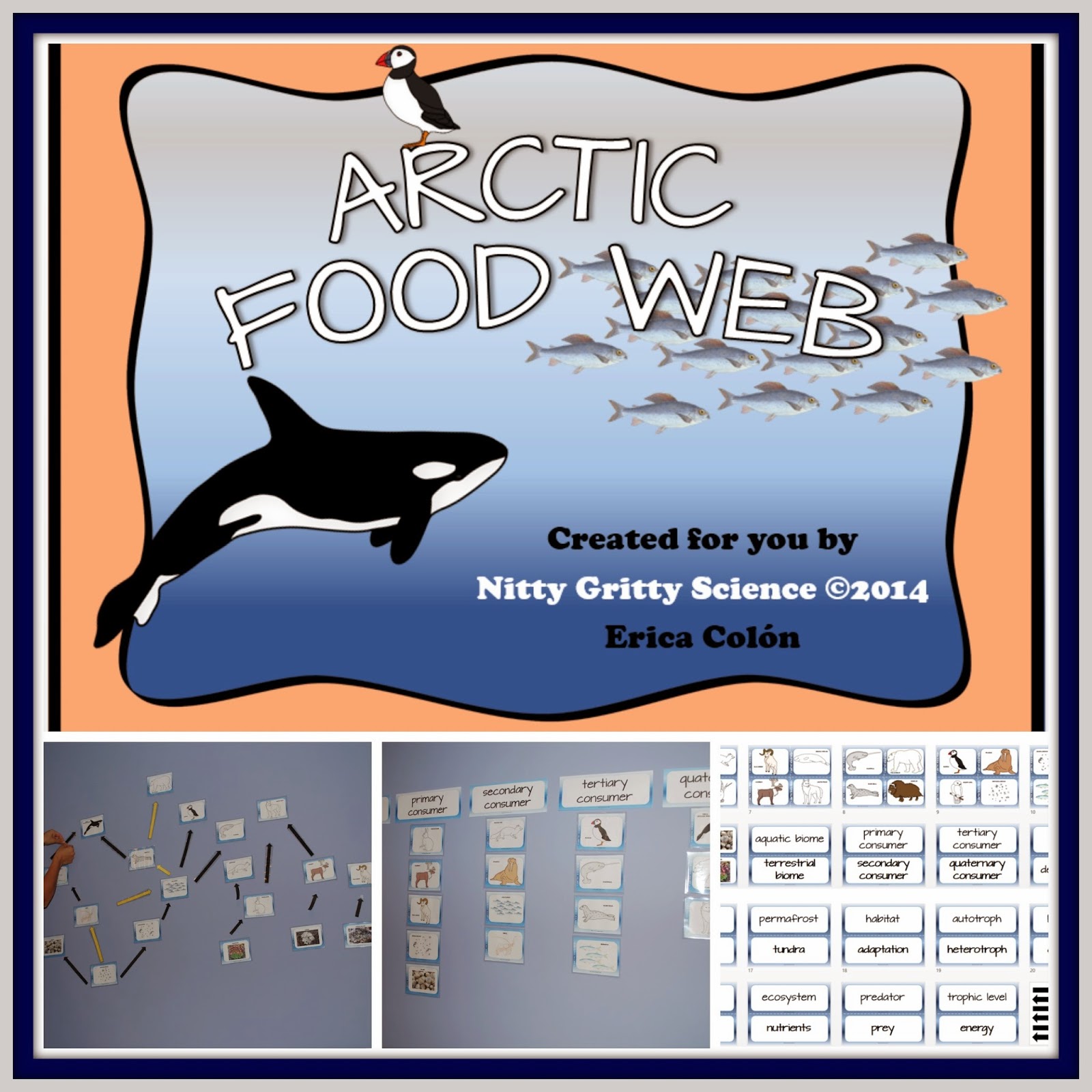
Arctic Food Web - An Interactive Ecology Lesson

We all know that students love any excuse to talk and move about the classroom being the social creatures they are. So, why not use it to your advantage and find science activities that get them up and working together.  This Arctic Food Web activity is a great example when you're teaching Ecology.  Pass out organism cards featuring consumers and producers of the Arctic along with cut-out energy arrows and have students build a giant Food Web Wall where they will be able to visualize the different food chains and understand how the feeding relationships affect the energy flow in an ecosystem.
Another idea is to get students using their science vocabulary by having them post the Arctic Food Web pictures under the the proper terms on a Word Wall so they can help you with the ongoing, interactive display of ecology terms.

You can find these great activities along with three others that include reading comprehension of the Arctic Ecosystem, Trophic Levels and Aquatic and Terrestrial biomes in the Arctic Food Web activity found by clicking the image below:

Have fun!

Eggmosis - Teaching Selectively Permeable Membranes with Eggs

This post came about because I was trying to prove to my friend that I could remove the shell of a raw egg and still keep its contents in tact.  Because it takes a few days, I took pictures to send as proof and voila, not only to I have hard proof, but I have a neat little science demonstration to share!

Because of the inner membrane underneath the shell, an egg is a perfect tool when teaching students about selectively permeable membranes.  This demonstration takes seconds to set up and can be left out for a few days for students to observe.  Materials needed are: raw egg, vinegar, karo syrup.


Day 1: Take raw egg and cover with vinegar - the acetic acid will take about 24 hours to dissolve the shell which is made of calcium carbonate, giving off carbon dioxide bubbles as seen below. Sometimes more vinegar needs to be added if you really want all the white of the shell to disappear.

 Day 2: Rinse off egg carefully under water and show students the difference in size next to a raw egg.  Another thing to have handy is a scale if you want to have them follow the increase in mass.
Day 2 cont.: After students have made observations, a discussion can begin about osmosis and cells being placed in a hypotonic solution (solution where water content is higher than that of cell).  Next, have students predict what will happen to vinegar-soaked egg once it's placed in karo syrup overnight...
 The karo syrup is a hypertonic solution (solution where water content is lower than cell), therefore, the permeable membrane of the egg allows water to leave the cell and move into the syrup.    Here's a pic of all three eggs: vinegar-soaked, syrup-soaked and raw.  Easy and memorable!!!  Have fun!

Bubble Plasma Membrane Demo

Well, my New Year's Resolution was to start adding posts to this blog to share my ideas...it's now February so I better get my act together :)
Good old Punxsuatawney Phil gave us a few more weeks of winter, so better make the most of it and have a little fun indoors.
A great way to do this is to play with bubbles and bubbles (I think) are THE perfect tool when trying to teach the properties of the plasma membrane.

Using two straws, make a frame to use as your bubble maker:

Once the frame is complete, mix up some bubble solution in a cookie sheet or tray and start your Plasma Membrane demonstrations such as...flexible boundaries


...or semi-permeable membranes...

...or really get a reaction from the students when you demonstrate embedded proteins by taking a piece of looped thread, placing it on the bubble solution and popping the inner circle to represent a protein channel. Also, move the thread loop around to help explain to students that the cell membrane can "repair" itself when the proteins move around the membrane.


Students can also complete this activity in groups - I give students directions on how to complete each activity, then I have them summarize the comparison between the behavior of the soap bubble to that of a plasma membrane in their Life Science Interactive Notebooks.  You can find this activity and more in the Life Science Interactive Notebook - Cells: Structure and Function chapter of my Interactive Notebook series.

Spring Is In the Air

Depending on where you are in the country Spring may or may not be trying to show her sunny face.  Here in Florida, yellow pollen has blanketed everything in the neighborhood, which means runny noses, congestion and conversations about the birds and the bees…no, no, no not THAT conversation, I mean the conversation about the Birds, Bees and Botany, of course.

In this unit you will not only find the perfect activity for teaching about pollinators, but also engaging lessons on seed dispersal, vascular tissue, plant life cycle and more...
...and speaking of Spring, have a wonderful & restful Spring Break!

Photobucket
Related Posts Plugin for WordPress, Blogger...